Today we’re introducing Quick Check, a new review mode inside IndexerLabs that makes manual verification of index entries fast, simple, and efficient.
Quick Check is built for a very straightforward purpose: sometimes editors, authors, and publishers want to manually inspect a sample of entries before they sign off on an index. In some cases, they may even want to review everything. We built this feature to make that process easy.
This matters because we care deeply about accuracy and usability.
Accuracy has been a major focus of our work from the beginning. In our article on verifying 20,000 locators at scale, we described the structured verification pipeline we use to validate locator claims before they make it into a final index. In our benchmark work on indexing the same book 120 times, we also showed that our system can preserve the topical core of a professional human index far better than the general-purpose models we tested. More recently, with our DOCX embedding work, we built a delivery workflow that effectively eliminates the usual last-mile locator drift that can happen when page numbers shift between indexing and final production.
But strong underlying performance is only part of the problem. In real publishing workflows, people still want ways to inspect the work for themselves. An editor may want to sample-check a few dozen entries. A publisher may want to review a broader slice of the index before delivery. A professional indexer using the platform may want the option to move through entries quickly and confirm them by hand.
Quick Check is our solution to that.
What Quick Check does
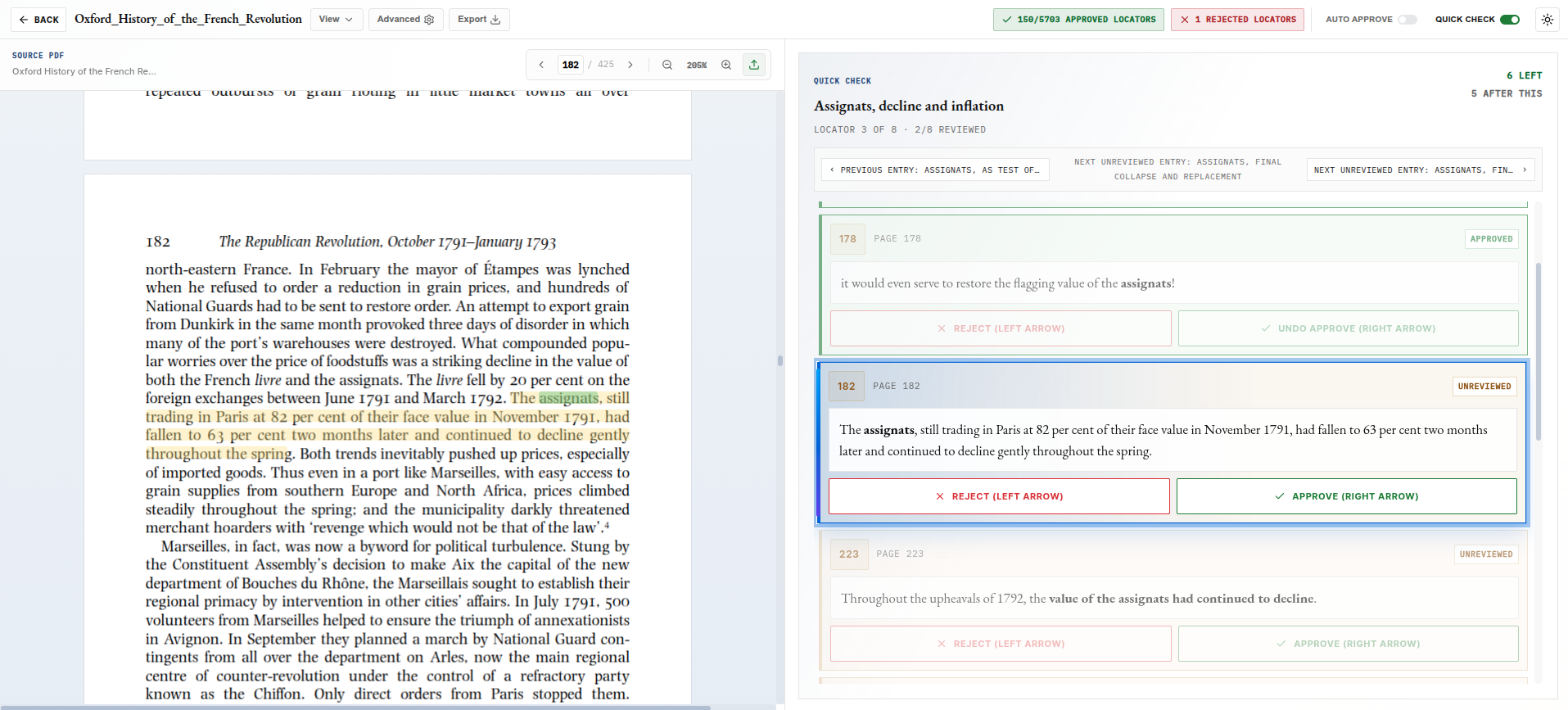
Quick Check gives you a fast, macro-driven review workflow for locator verification.
The source page stays visible on the left. The current entry appear on the right. Unreviewed items are presented in sequence and highlighted in the source document so you can move through them rapidly without hunting around the document or clicking through layers of interface.
The workflow is intentionally simple:
- Right arrow to approve
- Left arrow to reject
- Up/Down arrows to navigate between entries
Bring the relevant evidence into view, reduce the friction of each decision, and let the reviewer keep moving.
Built for real editorial workflows
We designed Quick Check around the way people actually review indexes.
In many cases, a user does not want to audit every single locator. They want to spot-check enough of the index to develop confidence that the system is doing what it should. They want to look at real entries, see the source context, and verify that the results match the standards they expect.
Quick Check makes that easy.
You can move through a hundred locators in just a few minutes. You can inspect more broadly if the project calls for it. And if you do want to manually verify everything, the feature is fast enough to make that a realistic afternoon job rather than a painful multi-day process.
A workflow like this changes the character of review. Instead of turning verification into a slow editorial bottleneck, it turns it into a rapidly efficient final pass.
Professional indexers know how difficult it can be to verify an existing index, especially when the locator does not map cleanly back onto the page and the reviewer has to stop, search, and reconstruct the evidence manually. Quick Check is built to remove that friction. In IndexerLabs, every locator can already be tied back to explicit textual evidence, and the interface shows that evidence visually by highlighting the exact sentence and term that justified the entry in the first place. That makes review much faster. Instead of hunting around the document, the reviewer can see the claim, see the evidence, and approve or reject it immediately with a simple keyboard-driven workflow. The result is a much lighter manual pass: easy sample-checking when an editor wants to inspect a few entries, and fast enough full review that a user can move through hundreds of locators per hour and, in many cases, roughly a thousand in a focused session.
Fast enough to be useful
The whole point of Quick Check is speed.
Once the source context is already visible and the next unreviewed locator is already queued, a reviewer can move very quickly. Approve. Reject. Advance. Repeat.
That makes it useful in two different ways.
First, it makes sample-based validation easy. If an editor wants to check a slice of the index before approving it, they can do that quickly and build confidence without interrupting the entire workflow.
Second, it makes full manual review possible for teams that want the extra oversight. The interface is light enough that working through a large number of locators becomes practical.
That kind of speed matters. Even when the system is already producing strong results, usability still determines whether review feels smooth or exhausting.
Accuracy and usability go together
We do not think users should have to choose between a highly automated workflow and a transparent one.
The best indexing systems should be able to generate high-quality results from the start while still giving users clean, efficient ways to inspect the work when they want to. That is especially true in publishing, where trust is built through both performance and reviewability.
We want every part of the indexing process to be reliable, inspectable, and practical for real users. That means strong models, strong verification, and strong interfaces.
Quick Check is a new part of that effort, and we’re excited to keep building on it.