AI Book Indexing Tool for Authors and Publishers
Creating a high-quality book index has traditionally been one of the most time-consuming parts of publishing a nonfiction book. A good back-of-book index requires more than finding repeated words. It requires judgment: deciding which people, concepts, places, arguments, and themes matter enough to be included, how those entries should be phrased, when subentries are useful, and which page references actually help the reader.
IndexerLabs is an AI book indexing tool built for authors, publishers, editors, and scholarly presses that need a professional back-of-book index without waiting weeks or manually building one from scratch.
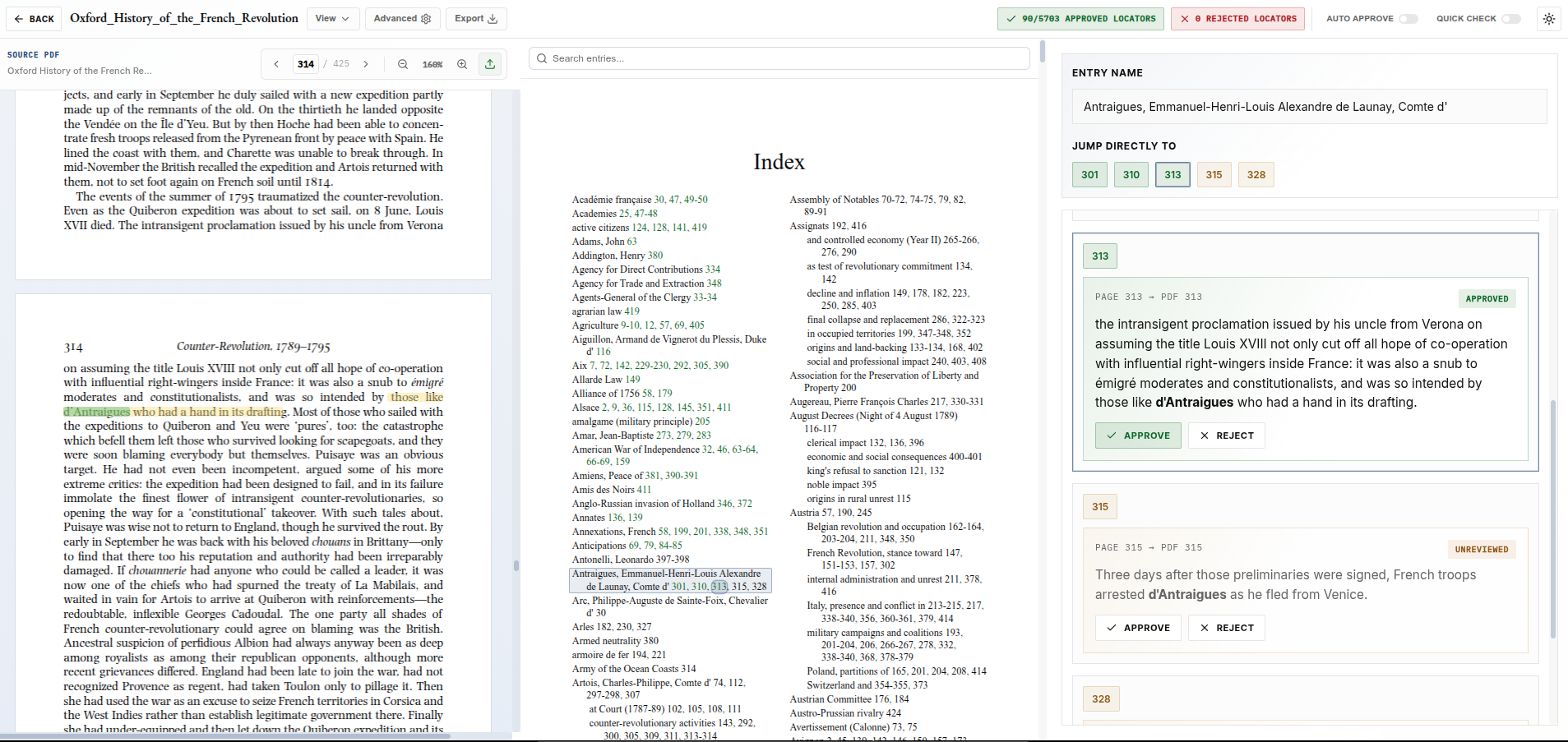
View a side-by-side comparison of a professional human index versus our AI-generated output for a 425-page scholarly volume.
View Oxford History Demo →Unlike a simple keyword extractor or generic AI chatbot, IndexerLabs is designed around the actual structure of a publishable index: top-level entries, subentries, locator verification, review workflows, and export formats that fit real publishing processes.
Whether you are preparing an academic monograph, trade nonfiction book, edited volume, theological text, historical study, or open-access publication, IndexerLabs helps turn a finished manuscript into a structured, reviewable book index.
What Is an AI Book Indexing Tool?
An AI book indexing tool is software that uses artificial intelligence to help create a back-of-book index from a manuscript. At its simplest, this might mean identifying important names and terms. A more advanced system goes further: it evaluates which concepts deserve index entries, groups related material, proposes subentries, assigns locators, and prepares the result for human review.
A real book index is not just a list of words that appear in a book. It is a reader-facing map of the book’s ideas.
For example, a keyword tool might notice that the phrase “French Revolution” appears many times. A useful index has to make more careful decisions:
- Should “French Revolution” be a main entry, a subentry, or part of several related entries?
- Which pages contain substantive discussion rather than passing mentions?
- Should related concepts such as monarchy, republicanism, violence, reform, and popular sovereignty appear separately?
- Should there be subentries under broad topics?
- Should the entry point to related terms with cross-references?
That is the difference between keyword extraction and book indexing.
Why Book Indexing Is Difficult
Book indexing is deceptively hard because the best index entries are not always the most frequent nouns or words in the manuscript.
A person, concept, or event may appear only a few times but still be essential to the argument. Another term may appear dozens of times but be too generic to deserve its own entry. A good index has to distinguish between meaningful discussion and incidental mention.
This is especially important in scholarly and nonfiction books, where readers often use the index to answer precise questions:
- Where does the author discuss a particular person?
- Where is a concept treated in depth?
- Where does a theological, historical, legal, or philosophical issue appear?
- Where are related arguments spread across different chapters?
- Which pages are worth reading, rather than merely containing the word?
A professional index also needs structure. It has to avoid becoming either too thin or too bloated. It has to choose useful headings, merge duplicate entries, create readable subentries, and format locators consistently.
That is why simply asking a chatbot to “make an index” from a book is usually not enough. Full-book indexing needs a workflow designed for long documents, page references, editorial review, and publication constraints.
How IndexerLabs Creates a Book Index with AI
IndexerLabs uses a staged indexing workflow rather than trying to generate an entire index in a single prompt.
The process is designed to separate the major parts of book indexing:
- Candidate discovery — identifying people, places, concepts, events, works, and themes that may belong in the index.
- Editorial selection — deciding which entries are important enough to keep.
- Entry refinement — improving phrasing, merging duplicates, and organizing related terms.
- Subentry generation — creating useful subentries where a broad topic needs internal structure.
- Locator extraction — assigning page references or evidence locations to entries.
- Verification and review — making the index inspectable before publication.
- Export — producing an index in a format that fits the author’s or publisher’s workflow.
By breaking the problem into stages, IndexerLabs can produce an index that is easier to review, easier to correct, and easier to trust.
More Than a Keyword Extractor
Many automated indexing systems begin and end with word frequency. They look for proper nouns, repeated phrases, or statistically significant terms. That can be useful for brainstorming, but it does not produce a professional back-of-book index on its own.
A keyword list might include every repeated term in a manuscript. A book index should include the terms that matter to readers.
IndexerLabs is designed to evaluate entries in context. The goal is not merely to ask, “Does this word appear?” The better question is, “Would a reader reasonably expect to find this topic in the index, and would this locator help them?”
Built for Professional Back-of-Book Indexes
IndexerLabs is built around the features authors and publishers expect from a serious book indexing workflow.
Top-Level Entries
First, the system identifies major names, concepts, events, places, works, and themes that may deserve index entries.
Optional human review
Second, our Checkpoints workflow can pause the indexing process and send the proposed term list for human review. At this stage, authors and editors can edit, delete, or add terms before mass extraction begins. They can also review the system’s reasoning for why each candidate term was proposed.
Mass extraction
After the term list is approved, IndexerLabs runs repeated extraction passes across the full manuscript, reading the book up to 30 times from different indexing angles. This helps the system capture relevant discussions that might otherwise be missed by a single-pass AI workflow.
Subentries
Our system then detects broad topics, and produces subentries that help readers navigate large clusters of references. Instead of sending the reader to a long, undifferentiated list of pages, subentries help divide the topic into meaningful parts.
Locator Support
A book index is only useful if its locators are accurate and helpful. IndexerLabs is built around evidence-based locator extraction and review, so entries can be checked directly against the original manuscript rather than accepted on trust.
Our Quick Check workflow makes this review process dramatically faster. By pairing each proposed index entry with manuscript evidence and keyboard-driven review controls, it allows a reviewer to verify up to a thousand entries in under an hour. That matters because AI book indexing should not merely generate plausible-looking entries; it should make those entries fast to inspect, correct, and trust before publication.
Embedded Word Indexes
For Word documents, IndexerLabs can support embedded index workflows using Word index markers. This makes the index more resilient when page numbers shift during layout or revision.
AI Book Indexing Tool vs. ChatGPT
Many authors first wonder whether they can use ChatGPT to create a book index. For short documents, a chatbot can be useful for brainstorming possible terms, headings, or categories. For a full-length book, however, there are serious limitations.
The first limitation is context length. A nonfiction manuscript may contain 80,000, 100,000, or even 150,000 words. Since one token is roughly three-quarters of a word, a 100,000-word manuscript is already about 133,000 tokens before footnotes, bibliography, front matter, formatting, prompts, or instructions are included.
That matters because ordinary chat interfaces are often much smaller than a complete manuscript. As of April 2026, GPT-5.3 Instant in ChatGPT has a 16K context window on the Free tier, 32K on Plus and Business, and 128K on Pro and Enterprise. GPT-5.5 Thinking provides a larger context window only when Thinking is manually selected: paid tiers receive 128K input tokens plus up to 128K output tokens, while the Pro tier receives a 400K total context window, with 272K input tokens and up to 128K output tokens.
In other words, many common ChatGPT sessions cannot hold a serious nonfiction manuscript in active context. Even when the manuscript technically fits, the model still needs room for instructions, reasoning, intermediate structure, and the index itself. Uploading a book is therefore different from having the model read, retain, and use every part of the book consistently.
There is also the well-known “lost in the middle” problem. Long-context models often perform best when relevant information appears near the beginning or end of a long input, while details buried in the middle can be easier to miss. That is a serious problem for book indexing, because an index depends on even coverage across the whole manuscript. A minor but important discussion on page 214 may deserve an index entry just as much as a major term introduced in the first chapter.
This makes “just paste the book into a chatbot” a fragile indexing strategy. A generic chatbot may struggle with:
- long manuscripts
- page-number accuracy
- distinguishing passing mentions from substantive discussion
- maintaining consistent entry phrasing across hundreds of pages
- creating useful subentries
- avoiding overbroad or redundant entries
- providing evidence for each locator
- exporting the index in a publisher-friendly format
Book indexing requires a system, not just a prompt.
IndexerLabs is built specifically for book indexing. It treats the index as a structured editorial product, with separate stages for candidate generation, entry selection, heading refinement, locator extraction, evidence review, and export.
AI Book Indexing Tool vs. Traditional Book Indexing Software
Traditional book indexing software is usually designed for professional human indexers. These tools can be powerful, but they often assume that the human indexer is manually selecting entries, writing subentries, and assigning locators.
That works well for experienced indexers. It is less helpful for authors or publishers who need the index itself to be generated.
IndexerLabs fits a different need. It is an AI book indexing tool designed to help produce the index, not only manage it after a human has written it.
| Option | Best For | Limitation |
|---|---|---|
| Microsoft Word index tools | Manual embedded indexing | Slow for full books |
| Traditional indexing software | Professional human indexers | Requires manual indexing expertise |
| Keyword extraction tools | Finding repeated terms | Usually produces term lists that need extensive editing, not indexes |
| Generic AI chatbots | Brainstorming entries | Weak long-document and locator reliability |
| IndexerLabs | AI-assisted professional book indexing | Best suited for nonfiction and scholarly books |
The goal is not to replace editorial judgment with a black box. The goal is to make book indexing faster, more affordable, and easier to review.
Who Should Use IndexerLabs?
IndexerLabs is designed for people and organizations that need a serious book index but do not want to build one manually from scratch.
It is especially useful for:
- authors preparing a nonfiction book for publication
- academic authors facing a short indexing deadline
- university presses and open-access publishers
- editors managing multiple book projects
- independent publishers
- scholars producing monographs or edited volumes
- organizations publishing reports, reference works, or long-form research
The tool is especially well suited for books where the index needs to capture concepts, arguments, names, and themes rather than merely list repeated keywords.
Use Cases
Academic Monographs
Academic books often need detailed indexes covering people, concepts, primary texts, places, and theoretical terms. IndexerLabs can help create a structured draft index that the author or press can review.
Trade Nonfiction
For nonfiction authors, an index improves usability and credibility. IndexerLabs can help create an index without requiring the author to spend days manually marking entries.
Theological and Religious Studies Books
Books in theology and religious studies often require careful treatment of names, doctrines, texts, traditions, and scripture references. IndexerLabs is designed to support complex indexing workflows, including scripture-oriented indexing.
Historical Works
History books often contain many people, places, institutions, events, and themes. IndexerLabs can help organize these into a usable index rather than a long list of proper nouns.
Why Locator Accuracy Matters
An index entry is only as useful as its locators.
If a reader looks up a topic and lands on a page where the topic is barely mentioned, the index has failed. If the index points to the wrong page, the reader loses trust. If the index includes dozens of weak locators, it becomes harder to use than no index at all.
That is why IndexerLabs emphasizes verification and review.
The goal is not just to produce an index quickly. The goal is to produce an index that can be checked, edited, and trusted.
For authors and publishers, this matters because the index is part of the finished book. A weak index reflects poorly on the publication. A strong index helps readers, reviewers, librarians, and scholars use the book more effectively.
Embedded Indexing for Microsoft Word
Many authors and publishers work in Microsoft Word before final layout. Word supports embedded index entries using index fields, often called XE fields. These markers tell Word which terms should appear in the index and where they occur in the document.
The advantage of embedded indexing is that the index can update when the document changes. If page numbers shift, Word can recalculate the final index from the embedded markers.
Manually creating these markers can be slow. For a full-length book, it may require hundreds or thousands of individual decisions.
IndexerLabs can help automate this process by inserting index markers into the document, giving authors and publishers a more flexible path from manuscript to final index.
This is especially useful when a book is still moving through revision, formatting, or production.
Human-in-the-Loop AI Indexing
IndexerLabs is built around the idea that AI indexing should be reviewable.
A book index is an editorial object. Authors and publishers may want to remove entries, rename headings, add missing terms, adjust subentries, or reject weak locators. A good AI book indexing tool should make those decisions easier, not hide them.
That is why human review is part of the workflow.
Instead of presenting the index as an untouchable final answer, IndexerLabs is designed to support inspection and correction. This allows authors and editors to combine AI speed with human judgment.
The result is a more practical workflow: the AI does the heavy initial work, and the human reviewer focuses on quality control.
How Long Does AI Book Indexing Take?
Traditional book indexing can take days or weeks, depending on the length and complexity of the manuscript. AI-assisted indexing can dramatically shorten the first-draft process.
The exact turnaround time depends on the book, the desired level of detail, and the review workflow. A short nonfiction book may require much less processing and review than a long academic monograph with dense terminology and many subentries.
The key advantage is that IndexerLabs can quickly produce a structured index draft that would otherwise require extensive manual work. From there, the author or publisher can review, revise, and export the result.
How Much Does AI Book Indexing Cost?
Professional human indexing can be expensive, especially for long or complex nonfiction books. Costs often depend on page count, density, subject matter, schedule, and the experience of the indexer.
AI book indexing offers a more affordable option for authors and publishers who need a usable, reviewable index without the full cost of a traditional manual indexing process.
IndexerLabs is designed to make professional-quality indexing more accessible, especially for independent authors, academic writers, small presses, and open-access publishers.
Our book indexing tiers start at $99 per book, which is up to 5-10x cheaper than our human counterparts for many projects, while being more than 50x faster and being of equal or superior quality to professional indexers.
Is AI Book Indexing Accurate?
AI book indexing can be accurate when it is built around the right workflow.
The weakest form of AI indexing is simple prompt-based generation: upload text, ask for an index, and hope the result is correct. That approach often fails because it does not adequately verify locators, handle long manuscripts, or support structured review.
A stronger approach treats indexing as a pipeline:
- identify candidate terms
- select important entries
- refine headings
- generate subentries
- extract locators
- verify evidence
- allow human review at critical stages
- export in a usable format
IndexerLabs follows this more structured model. The system is designed to make AI-generated indexes inspectable and correctable, so authors and publishers can evaluate the result before using it.
What Makes a Good AI-Generated Book Index?
A good AI-generated book index should be judged by the same standards as any other book index.
- Accurate — locators should point to relevant discussion.
- Selective — entries should reflect meaningful topics, not every repeated word.
- Readable — headings and subentries should be phrased clearly.
- Structured — broad topics should be organized with useful subentries.
- Consistent — names, terms, and formatting should follow a coherent style.
- Reviewable — authors and editors should be able to inspect and revise the result.
- Exportable — the final index should fit the publishing workflow.
IndexerLabs is built around these standards.
Why Authors and Publishers Use IndexerLabs
Authors and publishers use IndexerLabs because book indexing is important but often painful.
Manual indexing can be slow, expensive, and stressful, especially near the end of a publishing schedule. Generic AI tools can produce plausible-looking output, but they often lack the structure and verification needed for a real book index.
IndexerLabs offers a middle path: an AI book indexing tool designed specifically for professional back-of-book indexes.
It helps authors and publishers:
- create a structured index draft quickly
- reduce manual indexing work
- review entries before publication
- support subentries and complex subjects
- improve locator reliability
- export the index in practical formats
- make indexing more affordable
For many books, this can turn indexing from a last-minute production burden into a manageable editorial workflow.
Frequently Asked Questions
What is an AI book indexing tool?
An AI book indexing tool is software that uses artificial intelligence to help create a back-of-book index from a manuscript. A strong AI indexing tool identifies important entries, proposes subentries, assigns locators, and supports human review.
Can AI create a professional book index?
AI can help create a professional book index when it is used in a structured workflow with locator verification and human review. A generic chatbot prompt is usually not enough for full-book indexing, but a specialized AI book indexing tool can produce a much more useful result.
Is IndexerLabs different from ChatGPT?
Yes. ChatGPT is a general-purpose AI assistant. IndexerLabs is built specifically for book indexing, including candidate selection, subentry generation, locator extraction, verification, and export workflows. Furthermore, we don’t send or retain any of your data, and host all our models on our own private servers. This allows us to ensure your manuscript never leaves our ecosystem.
Can IndexerLabs create an index for a Microsoft Word document?
Yes. IndexerLabs supports workflows for Word documents, including embedded index markers that can be used to generate an index inside Microsoft Word.
Does an AI-generated index still need review?
IndexerLabs is designed to produce indexes that are usable without requiring authors or editors to rebuild them from scratch. Our public demos are intended to show the quality of the automated output before human editing, because the goal of AI book indexing should be real automation rather than simply shifting the work to a reviewer.
At the same time, we believe review and verification are critical for publication trust. That is why our platform makes review fast: each proposed entry can be checked against manuscript evidence, revised, accepted, or rejected before final export.
What kinds of books work best with IndexerLabs?
IndexerLabs is best suited for nonfiction, scholarly, academic, historical, theological, philosophical, political, biographical, and technical books. It is especially useful for books where concepts and arguments matter, not only names and keywords.
Can IndexerLabs create subentries?
Yes. IndexerLabs can generate subentries for broad topics, helping readers navigate large clusters of references more easily.
How is AI book indexing different from keyword extraction?
Keyword extraction finds repeated or statistically important terms. Book indexing requires editorial judgment: deciding what belongs in the index, how entries should be phrased, which locators are useful, and how the index should be structured.
How much does IndexerLabs cost?
$99 per book to start - up to 5-10x cheaper than traditional means for many projects.
Is my manuscript private?
We do not send manuscript text to third-party AI APIs. Our indexing models run on our own private servers, and do not send any part of your book to third party AI providers, so manuscripts stay within the IndexerLabs processing environment. We also design our workflow around limited retention and manuscript privacy, which is especially important for unpublished books.
Create a Professional Book Index with AI
A good index makes a book more useful. It helps readers find names, concepts, arguments, and passages long after they have finished reading. For scholarly and nonfiction books, the index is not an afterthought. It is part of how the book is used.
IndexerLabs gives authors and publishers a faster, more affordable way to create a professional back-of-book index.
If you need an AI book indexing tool built for real manuscripts, accurate locators, subentries, Word support, and human review, IndexerLabs is designed for exactly that workflow.
Create your index with IndexerLabs.
Get Started