If you are wondering whether AI can help you create a professional back-of-book index, the answer is yes—but only if the technology is used in the right way. A good AI book indexing tool should do more than generate keywords. It should support real subject indexing, accurate locator verification, and output length control.
I first encountered the problem of automated book indexing last year while helping produce a series of indexes for an acquaintance of mine. We spent more than eight days painstakingly reading through his book, noting entry occurrences, and recording page numbers. The process was extremely tedious and time-consuming, and we were both surprised to discover how few genuinely useful automated solutions existed.
The “AI” indexing tools available at the time were disappointing. Some generated extremely long, poorly structured indexes that were little better than keyword dumps. Others still required such extensive review, correction, merging, and cleanup that they offered little of the real automation we had hoped to find.
That frustration eventually led us to build IndexerLabs.
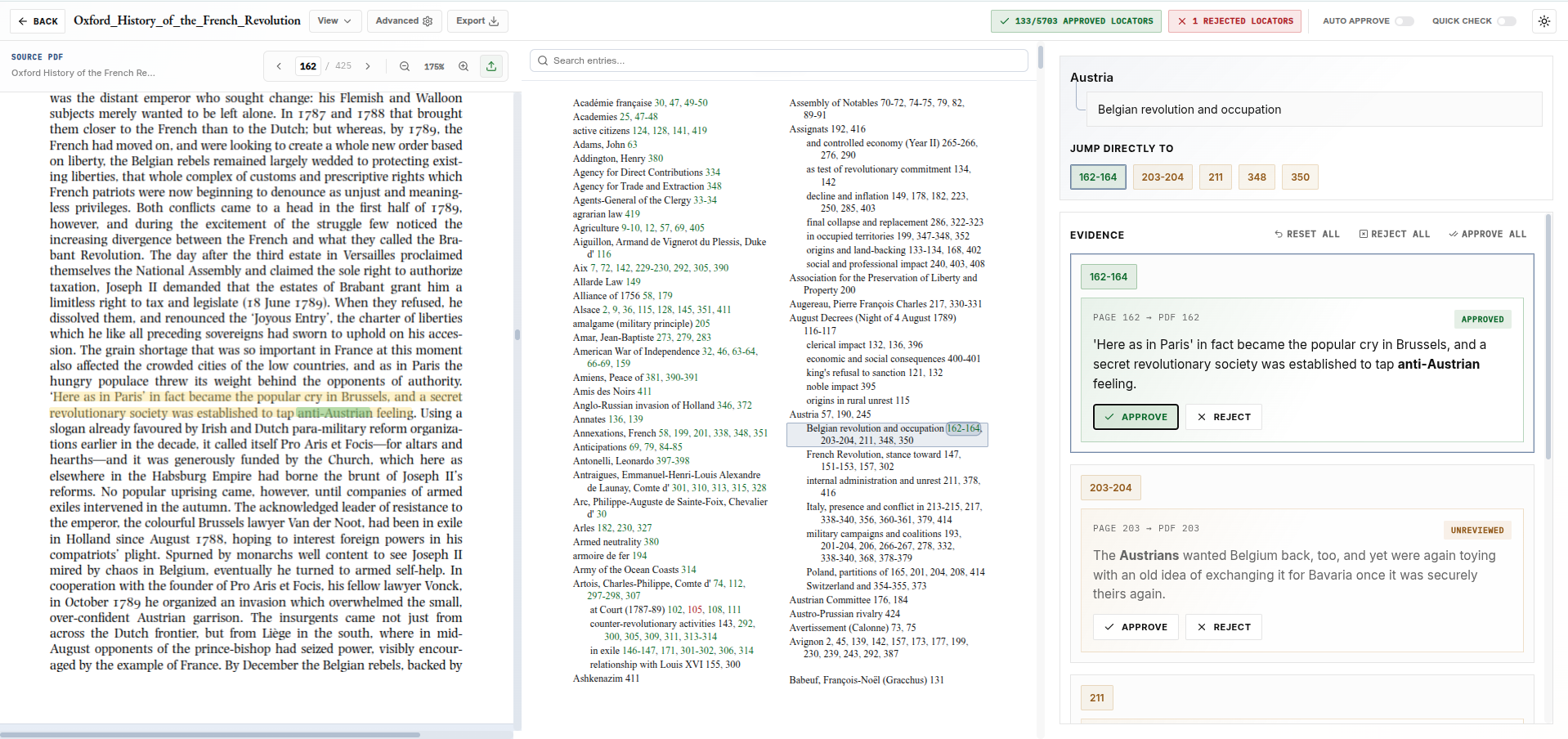
Rather than placing an entire book into a generic chatbot and asking it to produce an index in one pass, we process the manuscript page by page through a specialized workflow. Each page is analyzed by our AI individually, the candidate entries are compiled into structured data, and the draft is then refined through 9 additional stages that merge duplicates, organize related concepts, and verify page numbers against the source text.
We were also cautious about relying on general-purpose chatbot platforms that might retain or log manuscript data. For that reason, we run our AI models on infrastructure we control in Germany, so your files are never sent to third-party AI providers.
Verification and reliability first
Our system is highly transparent and verifiable. In initial prototypes of our software, we realized that ensuring page numbers were accurate would be a top priority. This led us to develop a highly robust and verifiable extraction system which ensures that every term our AI system extracts appears on the page it claims it is.
- Our system ensures that there are no “hallucinations’” within the index produced.
- Our system also allows you to quickly and easily view the exact sentence in which any given term is indexed.
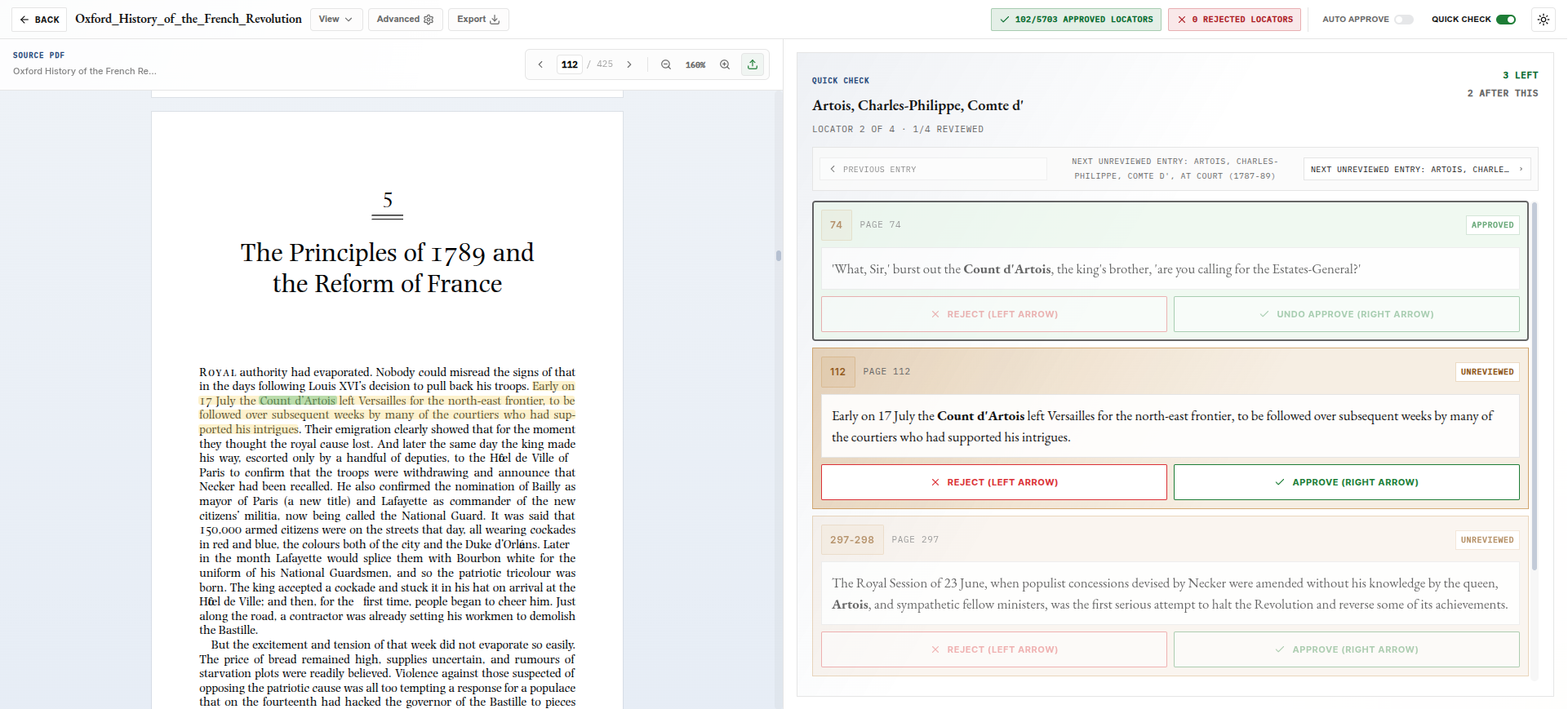
If one were so inclined, they could verify every single entry and locator within the index in under a few hours. This process can be additionally expedited by our “Quick Check” mode, which allows one to use powerful macros to rapidly review and verify entries.
Automatic subentry generation
Our system can automatically identify large entries and break them down into subentries. For example, an entry like
is technically correct, but
is a much more helpful and accessible structure to the reader.
Our AI system automatically finds the most central themes and topics in your book that would most benefit from subentries, and then creates and formats them for you.
Elegant and Controllable
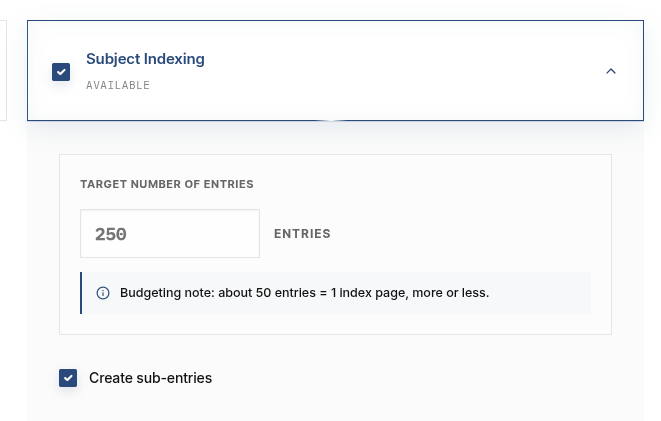
One of the most frustrating outcomes in indexing is to finish a draft, submit it, and then discover that it is far too long or far too short for the publisher’s requirements. Index length is not a minor detail; it is a practical production constraint.
For that reason, we designed IndexerLabs to give users fine-grained control over the final size of the index. By giving the system a clear page budget or target length, users can guide it toward a result that fits the needs of the book more closely.
In practice, we have often found that length control improves quality as well. When the system is given a realistic budget, it is forced to prioritize more carefully, selecting the most useful entries, omitting weaker ones, and allocating space where it will be most valuable to the reader.
For authors and publishers exploring AI book indexing, the real question is not whether AI can generate index-like text. The real question is whether an AI book indexing tool can produce a back-of-book index that is accurate, readable, and practical to use. We believe the answer is yes—but only when AI subject indexing is built around verification, structure, and editorial control. That is what we have aimed to build with IndexerLabs.