How Much Does Book Indexing Cost?
Book indexing is often one of the last costs an author encounters before publication.
That timing matters. By the time the index is due, the book has usually been written, revised, edited, typeset, proofread, and prepared for production. The author is tired. The publisher is watching the schedule. The book still needs a back-of-book index.
The cost can be surprising.
A professional index may occupy only a few pages at the end of the book, but those pages represent a substantial amount of editorial work. The indexer has to read the book, identify important topics, distinguish central discussions from passing mentions, create useful entries and subentries, assign locators, check page references, remove weak entries, and revise the structure until the index fits the book.
That is why book indexing cost is not simply a matter of page count. Page count matters, but so do subject complexity, density, deadline, format, style requirements, and the amount of judgment required.
This guide explains how book indexing is usually priced, why professional indexing costs what it does, how AI book indexing changes the economics, and how authors and publishers should think about the tradeoffs.
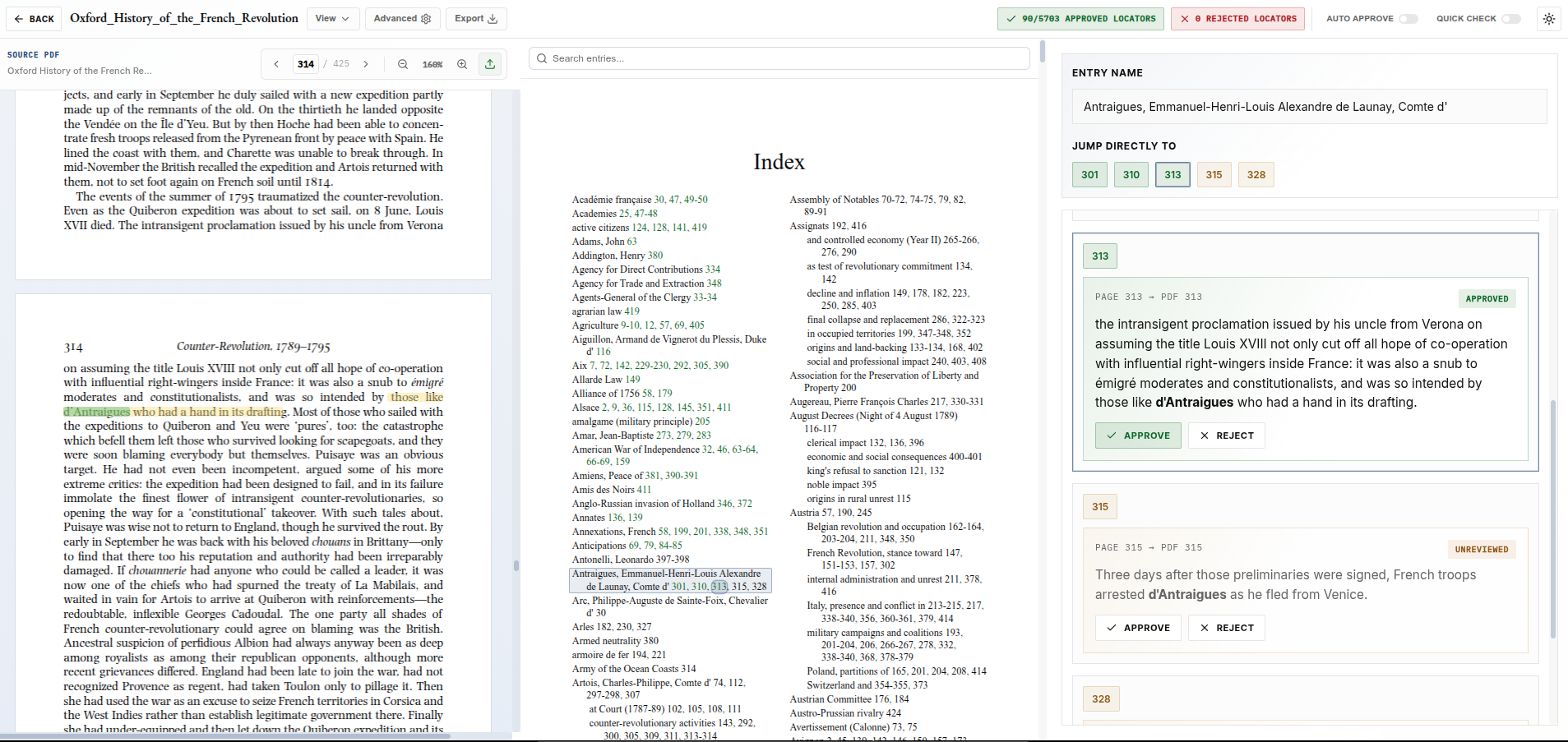
View a side-by-side comparison of a professional human index versus our AI-generated output for a 425-page scholarly volume.
View Oxford History Demo →Create your index with IndexerLabs.
Get StartedHow much does book indexing usually cost?
Book indexing costs vary widely.
The American Society for Indexing explains that book indexes are commonly quoted either per page or per entry, though those pricing methods ultimately reflect the amount of time the indexer expects to spend on the project. (American Society for Indexing)
The Editorial Freelancers Association’s 2026 rate chart lists book indexing at approximately 2.0-2.5 cents per word, $55-$60 per hour, or $5.00-$6.25 per 250-word page, based on its member survey data. (The Editorial Freelancers Association)
The UK Society of Indexers recommends, from January 1, 2026, baseline rates of GBP 34.00 per hour, GBP 10.30 per 1,000 words, or GBP 3.80 per page for a non-academic text, while noting that specialized texts and experienced indexers will often cost more. (Society of Indexers)
Those figures are not universal prices. They are reference points. A short, straightforward nonfiction book may cost far less than a dense academic monograph. A technical, legal, medical, theological, or heavily footnoted book may cost more. A rush deadline may also increase the price.
A practical way to understand the range is this:
| Book type | Likely cost pattern |
|---|---|
| Short, straightforward nonfiction | Lower cost; fewer concepts and fewer dense locators |
| Trade nonfiction | Moderate cost; depends on density and deadline |
| Academic monograph | Higher cost; more conceptual structure and scholarly apparatus |
| Technical, legal, medical, or scientific work | Often higher cost; terminology and accuracy demands increase |
| Embedded index in Word | May cost more; requires document-level marker placement |
| Rush project | Often higher cost; schedule compression matters |
The important point is that a professional index is not priced only by the number of pages in the finished index. It is priced by the work required to create it.
Why book indexing costs more than authors expect
A book index looks small because the finished object is small.
That can make the cost feel disproportionate. An author may look at a six-page index and wonder why it costs hundreds or thousands of dollars to produce.
The reason is that the final index compresses a large amount of judgment into a small space.
A weak index might say:
education, 12, 18, 19, 44, 77, 102, 118, 119, 203
A stronger index might say:
education
  classical curriculum and, 18–19
  democratic citizenship and, 77
  reform debates over, 102
  religious instruction and, 203
The second version is more useful because it does not merely tell the reader where a word appears. It tells the reader what kind of discussion happens there.
A professional indexer is not being paid to alphabetize terms. Software can alphabetize terms. The indexer is being paid to decide what belongs in the index, what should be omitted, how broad topics should be divided, which page references are useful, and what wording a reader is likely to search for.
The work is especially demanding because indexing usually happens near the end of production, when final page numbers are available and the schedule is compressed. The EFA notes that indexing is usually done near the end of a project, once final layout is ready and page numbers are unlikely to change. (The Editorial Freelancers Association)
That late-stage timing is one of the reasons indexing can feel stressful. The author has already done the main intellectual work of writing the book, but the index still requires careful attention.
What affects the cost of a book index?
The cost to index a book depends on several variables.
Page count
Longer books usually cost more because there is more text to read and more material to evaluate. But page count alone is not enough. A 250-page book with dense technical discussion may be harder to index than a 350-page book with a more narrative structure.
Word count
Some indexers price by word count rather than page count. This can be more precise when page layouts vary widely. A book with small type, narrow margins, and dense footnotes may contain far more words per page than a lightly designed trade book.
Subject complexity
A general-interest nonfiction book is usually easier to index than a specialized academic or technical work. Complexity affects not only reading time but also terminology, subentry structure, and the number of decisions required.
Density of names and concepts
Books with many people, places, organizations, works, legal cases, scripture references, technical terms, or historical events usually require more indexing work.
A political biography, for example, may require careful treatment of names. A theological work may require scripture references. A legal text may require statutes and cases. A history book may require people, places, events, institutions, and concepts.
Footnotes and endnotes
Notes can complicate indexing. Some notes contain material readers may want to find. Others are purely bibliographic. The indexer has to decide what should be indexed and what should be ignored.
Subentries
Broad topics require subentries. A book that discusses “democracy,” “religion,” “education,” “capitalism,” or “natural law” across many chapters will usually need more structure than a book with mostly discrete names and topics.
Subentries improve usability, but they take time.
Style requirements
Some publishers have specific indexing requirements. They may specify alphabetization rules, page range conventions, treatment of names, cross-reference style, or maximum index length.
More constraints can increase the work.
Embedded index requirements
A static back-of-book index is one thing. An embedded Word index is another.
An embedded index requires placing markers inside the document so that the index can be regenerated if pagination changes. That workflow can be valuable, but it requires document-level handling rather than simply producing a separate index file.
Deadline
Rush indexing can cost more because it compresses skilled editorial work into a shorter period. The indexer may have to rearrange other work or devote long concentrated hours to the project.
Review expectations
Some projects need only a finished index. Others require rounds of review, collaboration with the author, publisher-specific revisions, or special export formats.
The more review and coordination required, the more the project may cost.
Common book indexing pricing models
There are several ways to price a book index.
Per page
This is one of the most common methods. The indexer quotes a rate for each indexable page.
The advantage is predictability. The author or publisher can estimate the cost once the page count is known.
The disadvantage is that pages vary. A dense academic page is not equivalent to a lightly designed trade page. Two books with the same page count can require very different amounts of work.
Per word
Per-word pricing can be useful when page density varies or when the book has not yet been typeset.
The advantage is that word count measures the amount of text more directly than page count.
The disadvantage is that indexing still depends on complexity. A highly technical 60,000-word book may take longer than a more straightforward 80,000-word book.
Per entry
Some indexes are priced by the number of entries. The American Society for Indexing notes that per-entry pricing can be used when the parties are clear about what counts as an entry and when the expected number of entries is specified. (American Society for Indexing)
The advantage is that this can better reflect dense projects.
The disadvantage is that entry count is not always known at the beginning.
Hourly
Hourly pricing reflects the actual time spent.
The advantage is fairness when the scope is uncertain.
The disadvantage is that authors and publishers often want a predictable cost.
Flat project fee
A flat fee gives the buyer a clear price.
The advantage is simplicity.
The disadvantage is that the indexer must estimate the amount of work accurately. If the book is more complex than expected, the fee may not reflect the labor required.
A simple comparison of indexing options
There is no single correct way to index a book. The right workflow depends on the book, the budget, the schedule, and the level of review required.
| Option | Direct cost | Time cost | Best for | Main risk |
|---|---|---|---|---|
| DIY manual indexing | Low | High | Authors with time and indexing knowledge | Slow, uneven, easy to over-index |
| Professional human indexer | Moderate to high | Low to moderate for author | Complex, scholarly, high-stakes books | Cost and scheduling |
| Traditional indexing software | Software cost plus labor | Moderate to high | Professional indexers or trained authors | Helps manage the index; does not create it for you |
| ChatGPT or generic AI | Low | Moderate to high review burden | Brainstorming and limited assistance | Weak locators, context rot, no indexing workflow |
| AI book indexing tool | Lower fixed cost | Moderate review burden | Authors and publishers needing a structured draft quickly | Still requires review for best results |
Human indexer vs AI book indexing cost
A human indexer is not simply charging for page numbers.
A human indexer is charging for editorial judgment. That judgment includes reading the book, identifying the important discussions, deciding which passing mentions should be ignored, building subentries, creating cross-references, checking locators, and revising the index into a coherent structure.
AI book indexing changes the economics because some parts of that process can be automated or accelerated.
An AI book index generator can help with:
- candidate entry discovery;
- locating possible discussions;
- grouping related terms;
- suggesting subentries;
- detecting duplicates;
- providing locator support;
- pruning weak entries;
- producing a structured draft;
- exporting the index for production.
That does not mean review disappears.
The better claim is more limited and more useful: AI can reduce the blank-page burden. It can give the author or editor a structured draft to inspect, rather than requiring the entire index to be built manually from the beginning.
For many authors and publishers, that changes the cost equation.
A traditional human index may still be the best choice for complex scholarly or technical works. But for many nonfiction books, academic manuscripts, open-access titles, and small-press projects, AI indexing can make a usable back-of-book index economically feasible.
Why the cheapest index can still be expensive
A bad index can cost more than it saves.
The cost may not appear on the invoice. It appears later, when the index fails.
A poor index can create several problems:
- readers cannot find central topics;
- page references point to weak or irrelevant mentions;
- broad entries contain long undifferentiated page lists;
- duplicate headings scatter related discussions;
- important concepts are missing;
- the publisher requests revisions;
- the author has to repair the index manually;
- the book appears less professional.
The problem with a weak index is not only that it is incomplete. It is that it creates false confidence.
An index-shaped object may look acceptable at a glance. It may be alphabetized. It may contain page numbers. It may even include subentries. But if the locators are weak, the structure is inconsistent, or the main topics are missing, the index does not do its job.
This is especially important for AI-generated indexes.
The low direct cost of a generic AI workflow can be misleading if the review burden is high. If the author spends many hours correcting invented locators, merging duplicates, adding missing topics, and restructuring broad entries, the tool has not saved as much time as it appeared to save.
The useful comparison is not only price against price.
It is price plus review burden.
What does AI book indexing cost?
AI book indexing is usually less expensive than traditional human indexing because the system automates much of the draft-building process.
IndexerLabs uses tiered per-book pricing: $99, $199, and $299 per book for subject index generation, depending on the tier selected at checkout. (IndexerLabs)
That price difference matters, but it should be understood correctly.
The value of AI book indexing is not that indexing has become trivial. It has not. The value is that the workflow changes. Instead of starting from a blank page, the author or editor starts from a structured draft.
That draft can then be reviewed:
- Are the major topics present?
- Are the locators useful?
- Are passing mentions removed?
- Are broad topics divided into subentries?
- Are duplicate entries merged?
- Does the terminology match the book?
- Is the index the right length?
- Is the output ready for the publisher’s workflow?
This review is still editorial work. But it is usually more efficient than creating the entire index manually.
For a current package summary, see AI book indexing pricing.
Example: cost for a 250-page book
Consider a 250-page nonfiction book.
Using the EFA’s 2026 book indexing page range of $5.00-$6.25 per 250-word page, a 250-page book would imply a rough cost of $1,250-$1,562.50, before accounting for project-specific complexity, rush timing, or special requirements. (The Editorial Freelancers Association)
That estimate is not a universal quote. It is only an illustration of how professional indexing rates can scale.
A shorter or simpler book may cost less. A dense academic book may cost more. A per-word or per-entry quote may come out differently. An indexer may also charge more for specialized terminology, a compressed schedule, or embedded indexing.
By contrast, a flat-fee AI indexing workflow can be easier to budget. The tradeoff is that the author or editor should still review the generated index before publication.
Can authors index their own books?
Yes, authors can index their own books.
Sometimes they should.
An author knows the book’s argument, terminology, and audience better than anyone else. That knowledge can be valuable, especially in a scholarly or specialized work.
But author indexing has risks.
Authors often know too much about the book. They may include topics because those topics were important to the writing process, even if they are not useful to the reader. They may over-index minor points. They may assume readers will search using the author’s preferred terminology. They may struggle to distinguish central discussions from passing references.
There is also the time cost.
Indexing a book manually requires concentrated attention at the end of the publishing process, when the author may already be exhausted. It also usually happens when deadlines are tight.
DIY indexing may have no invoice, but it is not free. The cost is the author’s time, attention, and risk of producing an uneven index.
Is book indexing software cheaper than hiring an indexer?
Book indexing software can be cheaper than hiring an indexer, but it depends on what the software does.
Traditional indexing software is often designed for professional indexers. It helps create, manage, sort, format, and export indexes. That can be extremely useful. But it usually does not read the book and decide what belongs in the index.
In other words, traditional indexing software may reduce formatting and management friction, but the intellectual work remains with the user.
That distinction matters.
A tool that helps manage an index is not the same as a tool that generates an index. A professional indexer using software is still doing the indexing. The software supports the work; it does not replace the judgment.
AI book indexing tools attempt to move further upstream. They help generate the structured draft itself: candidate entries, locators, subentries, and reviewable output.
That is why the comparison should be made carefully:
| Tool type | What it usually helps with | What remains difficult |
|---|---|---|
| Microsoft Word indexing features | Marking entries and generating a Word index | Manual marking and judgment |
| Professional indexing software | Managing entries, sorting, formatting, exporting | Reading and selecting topics |
| Generic AI tools | Brainstorming terms and possible structures | Locator reliability and full-book consistency |
| AI book indexing tools | Draft creation, structure, locator support, review workflow | Final editorial review |
The lowest-cost tool is not always the lowest-cost workflow.
Is ChatGPT a low-cost way to index a book?
For a deeper treatment of this question, see Can ChatGPT create a book index?. ChatGPT can help with parts of indexing, but it should not be treated as a complete book indexing workflow.
It can suggest candidate entries. It can help reorganize rough headings. It can propose subentries for a known topic. It can explain indexing conventions. It can help an author think through whether related terms should be merged.
Those are useful tasks.
But asking ChatGPT to create the final index for a full book introduces several problems:
- the manuscript may exceed practical context limits;
- page structure may not be preserved;
- locators may be invented or weakly grounded;
- passing mentions may be over-indexed;
- central concepts may be missed;
- headings may be inconsistent;
- subentries may sound plausible without being supported by the text;
- the output may require extensive repair.
The issue is not that ChatGPT is incapable of helping. The issue is that indexing is an iterative editorial process, not a single generated answer.
A low direct cost can become expensive if the author has to spend many hours verifying and repairing the result.
When AI book indexing makes economic sense
AI book indexing is most useful when the alternative is not “a perfect human index at any cost,” but one of the more common real-world scenarios:
- the author has a limited budget;
- the production schedule is tight;
- the book might otherwise go without an index;
- the publisher needs a scalable workflow;
- the author wants a structured draft to review;
- the manuscript is nonfiction or academic but not unusually technical;
- the index needs to be produced quickly;
- the buyer wants predictable pricing.
In those cases, the economic value is clear.
AI indexing can reduce the cost of getting to a first serious draft. It can also make review more efficient by giving the author or editor an organized structure rather than a blank page.
The best use of AI book indexing is not to remove human judgment. It is to focus human judgment where it matters most.
The system can help build the draft. The reviewer can decide whether the draft reflects the book.
How to evaluate book indexing cost
When comparing indexing options, do not look only at the quoted price.
Ask what the price includes.
A useful evaluation should include these questions:
Does the price include review tools?
A generated index is more useful when the author or editor can inspect and revise it.
Does the index include subentries?
A list of main entries may be cheaper to produce, but broad topics often need subentries to be useful.
Are locators grounded?
Page references should point to meaningful discussions, not merely word occurrences.
Can the index be exported for publication?
The index should fit the production workflow. That may mean Word, PDF, plain text, IXML/CDFX, or an embedded DOCX workflow.
Is the price predictable?
A flat fee is easier to budget. A per-page, per-entry, or hourly price may be more flexible but less predictable.
How much author time is required?
A cheap tool that requires twenty hours of repair may not be cheap.
What happens if the manuscript changes?
If pagination changes, a static index may need revision. An embedded index or document-aware workflow may reduce that risk.
The real cost of indexing is not only the amount paid. It is the amount paid plus the time required to get to a publishable result.
Why a good index is worth paying for
A book index is a reader service.
It helps readers return to the book. It helps scholars cite the book. It helps teachers use the book. It helps reviewers, editors, librarians, and researchers locate the parts of the argument that matter to them.
A weak index makes the book harder to use.
A strong index makes the book more durable.
This is especially true for nonfiction and academic books. Readers of these books often do not read only from beginning to end. They return to topics. They search for names. They trace concepts. They follow arguments across chapters. The index makes that kind of reading possible.
Create a book index with IndexerLabs
IndexerLabs is built for authors and publishers who need a structured back-of-book index without starting from a blank page.
The workflow is designed around the parts of indexing that matter: meaningful entries, useful subentries, locator support, pruning, review, and publication-ready export.
Starting at $99 per book, IndexerLabs offers a predictable per-book alternative to traditional indexing, while still giving authors and editors a reviewable index rather than a loose keyword list. (IndexerLabs)
A good index is not merely a cost. It is part of the book’s usefulness.
IndexerLabs helps make that usefulness more accessible.
FAQ
How much does book indexing cost?
Book indexing costs vary by length, complexity, subject, deadline, and format. Professional indexers commonly price by page, word count, entry, hour, or flat project fee. The Editorial Freelancers Association’s 2026 rate chart lists book indexing at about $5.00-$6.25 per 250-word page, though actual project quotes vary. (The Editorial Freelancers Association)
How do professional indexers charge?
Professional indexers often charge per page or per entry, though some charge by word count, by hour, or by flat project fee. The American Society for Indexing identifies per-page and per-entry pricing as two common methods for quoting book indexes. (American Society for Indexing)
Why is book indexing expensive?
Book indexing is skilled editorial work. The indexer has to read the book, identify important topics, distinguish substantial discussions from passing mentions, create subentries, assign locators, check page references, and revise the final structure.
Can I index my book myself?
Yes. Authors can index their own books, but it takes time and care. The main risks are over-indexing, missing reader-facing terms, creating too few subentries, and including page references that are not actually useful.
Is AI book indexing cheaper than hiring an indexer?
Usually, yes. AI book indexing can reduce the cost of creating a structured draft index. The tradeoff is that the author or editor should still review the result before publication.
Is ChatGPT enough to index a book?
ChatGPT can help with limited indexing tasks, such as brainstorming entries or suggesting subentries. It is usually not enough for a reliable full-book index because indexing requires page-aware locators, consistent headings, pruning, revision, and review.
Is book indexing software cheaper than a professional indexer?
Software may be cheaper than hiring an indexer, but traditional indexing software often helps manage and format an index rather than create the index itself. The user still has to do the editorial work.
What affects the cost of a book index?
The main factors are page count, word count, subject complexity, density of names and concepts, notes, publisher style requirements, embedded index needs, deadline, and review expectations.
When is a human indexer worth the cost?
A human indexer may be worth the cost for complex academic, legal, medical, scientific, technical, or multilingual books, especially when the publisher has strict indexing requirements or when the index is part of the scholarly apparatus.
How much does IndexerLabs cost?
IndexerLabs subject indexing starts at $99 per book, with $199 and $299 tiers available at checkout. (IndexerLabs)
Create your index with IndexerLabs.
Get Started